


The growing reliance of enterprises on their IT assets can be problematic. What if a crucial piece of equipment goes missing? What if organizations fail to track their hardware’s warranties and face extra costs in repairs and replacements? Unfortunately, these are not just questions. They are becoming a reality in today’s tech-driven enterprise sector.
However, many organizations have adopted an enterprise asset management system to tackle these challenges. But what exactly do these systems do? And more importantly, how do they work? Let’s find out the answers
Evolution into Modern EAM
Today, you will find AI-driven, cloud-based enterprise asset management systems. But not so long ago, organizations were using spreadsheets, templates, and classic databases to manually track their hardware and IT assets. So, how did this evolution take place?
Originally, tracking physical assets relied heavily on manual data entry, which was both time-consuming and prone to errors. Furthermore, the lack of real-time insights and visibility led to inventory inaccuracies and operational inefficiencies.
Fortunately, the proactive approach of EAM systems has solved this problem. A modern enterprise management system like Teqtivity can automatically schedule maintenance, provide detailed reporting, update inventories, and ensure compliance.
Enterprise Asset Management System: As We Know It Today
Modern EAM solutions employ a cloud-based, centralized approach, enabling organizations to track real-time data analytics through centralized, visual dashboards. This makes it easier than ever to identify critical assets, schedule preventive maintenance, and coordinate work order management. Most importantly, these solutions help prevent unplanned downtime, costly emergency repairs, overstocking, understocking, and other issues that hinder operational efficiency.
It is now essential for businesses to use advanced EAM software. If not, they might face the risks of poor enterprise asset management, which include:
- Non-compliance
- Data security threats
- Shadow IT
- Undermaintenance or overmaintenance
- Poor resource allocation
- Suboptimal budgeting
- Asset theft or misplacement
That is why outdated spreadsheets and manual processes are downright ineffective today. Enterprises now use thousands of IT assets, which makes them impossible to track without a real-time, centralized solution.
Special Focus: Hardware & IT Asset Management in Modern EAM
The evolution of the enterprise asset management system has completely changed how organizations manage and track their IT assets. Nowadays, enterprises understand that their growing ecosystem of physical assets is far more complicated than spreadsheets. That is why modern EAM solutions focus on tracking and managing thousands of assets with room for scalability.
- Why Specialized Hardware & IT Asset Management Solutions Matter
A significant 28% increase in the remote workforce was reported in 2023. This growing trend in remote and hybrid work environments is not slowing down anytime soon. However, the on-premise absence can make asset management even more challenging. That is why a specialized hardware and ITAM solution is a MUST-have for enterprises.
It helps organizations track, maintain, and secure their assets across multiple locations, users, and departments. A modern, specialized EAM solution can eliminate the common compliance, security, and cost issues that enterprises face with remote and hybrid work models. These systems ensure that critical assets are never underutilized, misplaced, or vulnerable to cyber threats. In addition, real-time inventory management helps IT teams maintain optimal resource levels, helping to avoid both overstocking and budget drains.
- Addressing Unique Challenges
Another benefit of modern EAM systems is their ability to address unique enterprise-specific challenges. They provide organizations with greater control over their asset movement and spare parts allocation to streamline and track maintenance activities.
EAM systems can easily integrate with CMMS to adopt automation. This way, organizations can eliminate the manual burdens of maintenance schedules and planning for repairs and replacements. Instead, they can take a proactive approach to maximize asset health and lifespan.
Tools like Teqtivity provide organizations with real-time insights into their assets. As a result, they can make smarter decisions to optimize asset performance, allocate resources more efficiently, and ensure compliance throughout the asset’s lifecycle.
How a Modern System Works: Step-By-Step
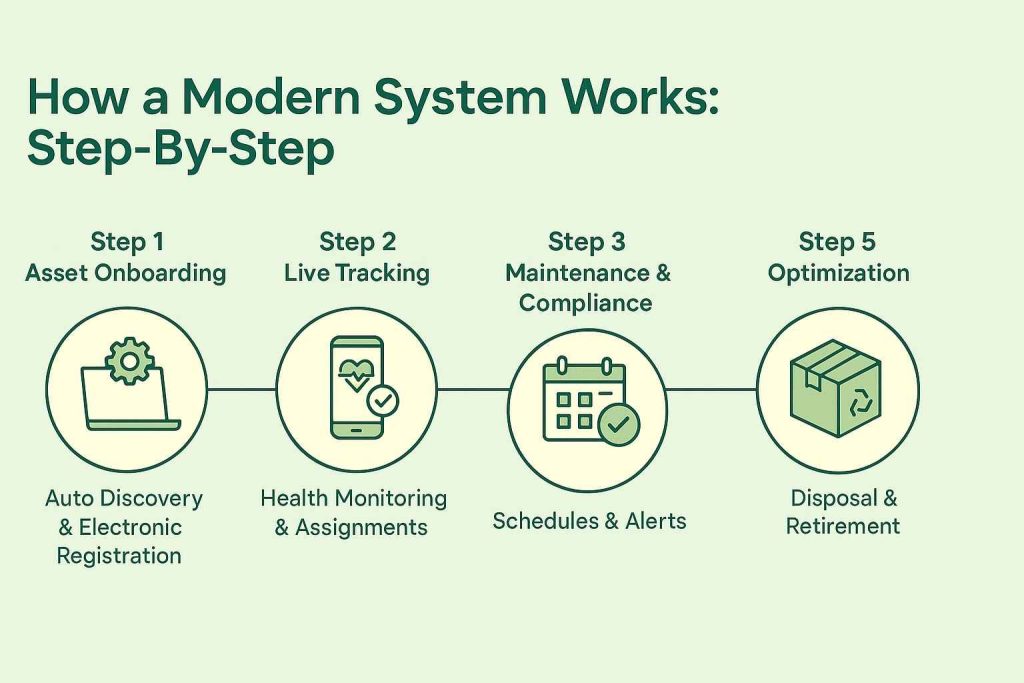
An enterprise asset management system takes a proactive, data-driven approach to managing hardware and IT assets. Below is a step-by-step process of how a modern EAM works:
Step 1: Asset Onboarding – Auto Discovery & Electronic Registration
Modern EAM solutions, such as Teqtivity, start the asset lifecycle management from the moment a new device enters the organization. These platforms use auto-discovery to integrate the new device into the system. Then, they immediately launch electronic registration to identify the asset and record it with full metadata.
Here’s how this process looks:
- EAM systems integrate with barcode tagging to ensure assets are uniquely identified and tracked across multiple locations, which is ideal for large teams and remote workforces.
- These modern solutions automatically log important asset details, like purchase date, model, specifications, assigned user, warranty, and other purchase data, to eliminate paperwork.
- Once the new device enters the inventory, EAM solutions start providing data about all assets from day one (procurement).
Step 2: Live Tracking – Health Monitoring & Assignments
After asset onboarding, the EAM system continuously monitors asset location, usage patterns, and performance.
Then, the enterprise asset management system provides the following features:
- EAM solutions offer real-time data streams through visual dashboards for tracking performance metrics.
- Next, these systems log and track essential configurations such as firmware and compliance settings.
- The EAM system immediately begins maintaining the security right away by flagging unauthorized device movement and non-compliant assets.
Step 3: Maintenance & Compliance – Schedules & Alerts
The next step for EAM software, such as Teqtivity, is to initiate predictive maintenance and automate compliance. Here’s how EAM does that:
- Enterprise asset management tools set up preventive maintenance plans and maintenance schedules after onboarding to ensure that no critical assets face unplanned downtime.
- Then, EAM systems provide real-time data alerts for expiring warranties, asset failures, or performance dips.
This proactive approach effectively reduces costs with minimal downtime and limited unnecessary repairs, which also prevents compliance violations.
Step 4: Optimization with Key Analytics
Today, EAM solutions are not just limited to asset management and tracking. They also provide key analytics that you can use to optimize operations, resource allocation, budgeting, and maintenance, .
A tool like Teqtivity provides detailed reporting to highlight patterns in inventory management and flag excessive stockpiles of spare parts. It can also help you with purchasing alerts to avoid understocking or stockouts. Furthermore, you can get recommendations for upgrades or replacements with an effective EAM system.
Integration further helps teams communicate data and optimize collaboration. For example, Teqtivity can seamlessly integrate EAM data with HR, procurement, finance, or external IT systems to eliminate duplicate purchases and redundant inventory entries. This, in turn, improves cross-departmental collaboration.
Step 5: Disposal & Retirement
Proper disposal of IT assets is just as important as making the right purchasing decisions. So, when an asset reaches the end of its operational life, an EAM system triggers its disposal/retirement workflows.
These workflows handle the following tasks:
- Automate processes to remove all organizational data, especially for IT and network hardware, as it can be used as an entry point for cyberthreats.
- EAM systems log each disposal in their audit trail, documenting the reason, method, and users involved to ensure full regulatory compliance.
- A modern EAM solution recommends an environment-friendly and compliant disposal method. This aligns businesses with today’s sustainability goals and minimizes the risk of data leaks.
An EAM platform like Teqtivity ensures that no asset is overlooked, even those flagged for disposal/retirement. In fact, it also monitors offboarding to safely secure devices during staff transitions to meet internal and external accountability standards.
Why Teqtivity for Modern Enterprise Asset Management?
The process of choosing the right modern enterprise asset management system can be quite challenging. That’s because the market is full of different solutions. Also, each tool solves a unique problem and offers distinctive highlights over others.
Even so, Teqtivity is one of the most effective tools for an enterprise asset management system. Here’s why:
- Scalable User-Based Pricing
Teqtivity offers user-based pricing to ensure that organizations of any size can benefit from its EAM solutions without additional costs. It further allows businesses to scale more easily. The pricing model can accommodate the increasing number of organizations’ physical assets and their growing needs.
- Workflow Automation
Teqtivity supports workflow automation that is customized to your industry-specific processes. It integrates key features like inventory management, compliance tools, and maintenance dashboards, all within a single dashboard.
The best part? Teqtivity allows you to set automated alerts for preventive maintenance, critical asset monitoring, and real-time ticketing to streamline business operations and minimize manual intervention.
- Security Excellence & Post-Incident Improvements
Teqtivity protects your IT infrastructure with essential security measures. This enables your organization to have safe and seamless offboarding to prevent asset losses and cybersecurity risks. Even better, Teqtivity supports integrations with MDRs (Managed Detection and Response) for quick recovery from security vulnerabilities.
- Asset Lifecycle Management for Predictive Maintenance
Teqtivity provides asset lifecycle management for predictive maintenance alerts and repairs/replacements. That’s because poor maintenance strategies have proven to reduce an asset’s overall productivity by 5% to 20%. Hence, Teqtivity takes a proactive approach to keep your hardware in optimal health. This approach also extends your device’s lifespan while minimizing unplanned downtime and costly emergency repairs.
Future Trends in EAM Systems
The modern enterprise asset management system solves the majority of the problems that organizations face with managing their hardware and IT equipment. However, the future trends aim to provide even more benefits.
These are the future trends according to the EAM system’s current trajectory:
- Future EAM solutions will expand automation and use artificial intelligence to predict potential failures, automate maintenance planning, and generate precise work orders before a problem even occurs.
- The shift toward hybrid and remote models is unlikely to slow down. That is why upcoming EAM trends aim to provide a centralized oversight of distributed physical assets and provide real-time data analytics. This will enable organizations to monitor configuration, compliance and performance of assets across diverse locations.
- Sustainability is one of the growing concerns in the EAM industry. Therefore, future EAM solutions will address end-of-life procedures, secure data erasure, and responsible recycling of old devices.
- Lastly, the potential of automation isn’t just limited to predictive maintenance. It will integrate more deeply into the organization’s workflows to create an audit-ready trail, ensuring that spare parts are reclaimed and aligning asset management with corporate social responsibility goals.
So, are you ready to implement an EAM system in your organization? Teqtivity might be just what you need. It can solve most of your enterprise’s issues, such as poor budgeting, inaccurate inventories, non-compliance, and inefficient operations. And yes, there’s a free demo to see how exactly it works!