


EAM (Enterprise Asset Management) is a strategic approach to tracking, maintaining, and optimizing the lifecycle and performance of all assets. But only a few organizations are using EAM solutions to optimize their key operations.
How? The right enterprise asset management solution can provide real-time control over IT hardware and warranties. It helps organizations maximize operational value, cut unnecessary costs, and maintain compliance throughout their processes. However, that’s not all an EAM can do. Let’s see how it truly optimizes operations in this blog.
Why EAM Matters for IT & Hardware Asset Management
With numerous tech tools and hardware components in use, managing assets at scale presents a significant challenge today. That is because enterprises face some of these unique challenges:
- Frequent asset loss
- Non-compliance pitfalls
- Unplanned downtime
- Wasted resources
- Increased costs
- Operational disruptions
Surprisingly, 39% of businesses still rely on manual processes. Similarly, many organizations use spreadsheets to track their assets even to this day, which is not only time-consuming but also error-prone. That is why many enterprises face inventory discrepancies, asset misplacement, theft, etc.
Furthermore, scalability is another problem enterprises face with outdated and manual asset tracking. These methods are definitely not scalable, especially if the organizations have a growing need for more devices and accessories. An EAM solution supports scaling businesses with these features:
- Preventive maintenance
- Integrated maintenance management
- Work order management
- Full asset lifecycle management
- Reduced downtime
- Minimal failure risk for any critical asset
- Real-time asset visibility
Simply put, an EAM system, such as Teqtivity, quickly adapts to the growing changes of an enterprise. As a result, IT teams optimize operations for optimal asset performance and minimal disruptions regardless of their asset portfolio size.
How EAM Enables Optimization – Step-by-Step
A modern Enterprise Asset Management (EAM) helps optimize business operations, but it’s not a one-and-done process. Instead, it works through a step-by-step approach. Let’s break down how EAM gets it done:
| Optimization Step | What Does It Do |
| Centralized Data Platform | Unified dashboard for all physical assets, IT hardware, and facilities |
| Automation | Automated asset assignment, updates, notifications, and role-based workflows |
| Real-Time Integrations | Connects with MDM, directory services, help desk, and procurement for full lifecycle automation |
| Proactive Maintenance | Schedules maintenance activities based on real usage data, not just time-based triggers |
| Analytics-Driven Decisions | Uses asset metrics for forecasting, budgeting, and downtime prevention |
The table above shows how EAM can enable optimization in businesses. Let’s discuss it in more detail below:
Step 1: Centralized Data Platform
The first step of an effective EAM is the creation of a centralized platform for all your physical assets. This centralization allows total visibility of your hardware and IT infrastructure through unified dashboards. Therefore, organizations can have these features:
- A streamlined inventory management of servers, laptops, network devices, and all other critical assets.
- Instant access to the full asset lifecycle management, starting from procurement and deployment to maintenance and disposal.
- The complete tracking of each asset movement, user assignment, and maintenance history.
In short, centralization isn’t just convenience, it’s a necessity for organizations routinely using hundreds or thousands of assets for key operations. When these assets are scattered across multiple locations, managing them becomes inefficient and costly. Centralizing resources helps organizations reduce budget drains linked with asset loss, duplicate purchases, and compliance gaps.
Step 2: Automation for Smarter Assignment & Updates
Modern EAM solutions, such as Teqtivity, benefit organizations through automation. These features can significantly reduce the burden on IT teams, saving them time and effort from repetitive tasks. In addition, automation can help enterprises with:
- Effective assigning and reassigning of assets to users and departments.
- Instantly updating inventory records with configuration changes.
- Pushing notifications to trigger warranty updates and renewal alerts.
- Enforcing role-based workflows to ensure only authorized users can request or change asset data.
Automation is key for digital success in today’s technology-driven market. A survey by Salesforce highlights that 74% of IT and engineering leaders believe that automation has helped their workforce save at least 11%-30% of their time that was previously spent on manual processes. In addition, 59% of people say they have experienced cost savings of 11%-30 % just by automating.

The chart above illustrates the time and cost savings achieved through automation in various departments.
Step 3: Real-Time Integrations for Connectivity
Optimization without integrations is incomplete. Tools like Teqtivity connect seamlessly with your existing systems to ensure connectivity across the enterprise. Most modern enterprise asset management software can integrate with these systems:
- Mobile Device Management: Integration with MDM is essential to receive immediate updates on all mobile devices connected to an organization. This enables businesses to maintain device security and compliance.
- Help Desk: EAM solutions connect with helpdesk platforms and ticketing systems for synchronized support requests and fulfillment.
- People Management: You can easily integrate an EAM system with an HR solution to track your workforce and user assignments.
- Procurement Software: Integrate an enterprise asset management system with a procurement system for real-time tracking from the moment you place an order to its fulfillment.
These integrations can completely eliminate data silos that create inventory discrepancies in an enterprise. Furthermore, they maintain unified, accurate records across all systems in your IT ecosystem.
Step 4: Proactive Maintenance for Predictive Alerts
Maintenance is often an overlooked aspect. However, timely maintenance is essential for organizations to operate smoothly. Without it, they face unplanned downtime and increased expenses due to costly emergency repairs.
In fact, a study by Aberdeen found that unplanned downtime costs industrial manufacturers approximately $50 billion each year. The solution? Proactive maintenance. Here’s how EAM can help with that:
- An effective EAM, such as Teqtivity, can schedule preventive maintenance based on an asset’s usage.
- EAM tools can track an asset’s history to detect potential issues before they even occur.
- A modern enterprise asset management system can automatically generate work orders when a device’s health indicators drop below thresholds.
- It can help you track maintenance activities through accurate and detailed logs.
This proactive approach can also help you extend the lifespan of your assets to get the maximum ROI on each device and warranty.
Step 5: Analytics-Driven Decisions
A modern enterprise asset management platform enables organizations to benefit from insights and actionable data. It provides IT teams with the key analytics, so they can:
- Identify underutilized hardware to allocate resources more efficiently.
- Forecast replacement needs and plan budgets with real-time asset health and lifecycle data.
- Analyze patterns in incidents or asset failures to guide improved maintenance strategies.
Therefore, real-time data and analytics are important for businesses to make data-driven decisions that directly optimize their operations, resource allocation, budgeting, compliance, and maintenance schedules.
EAM Use Cases for IT Asset Managers
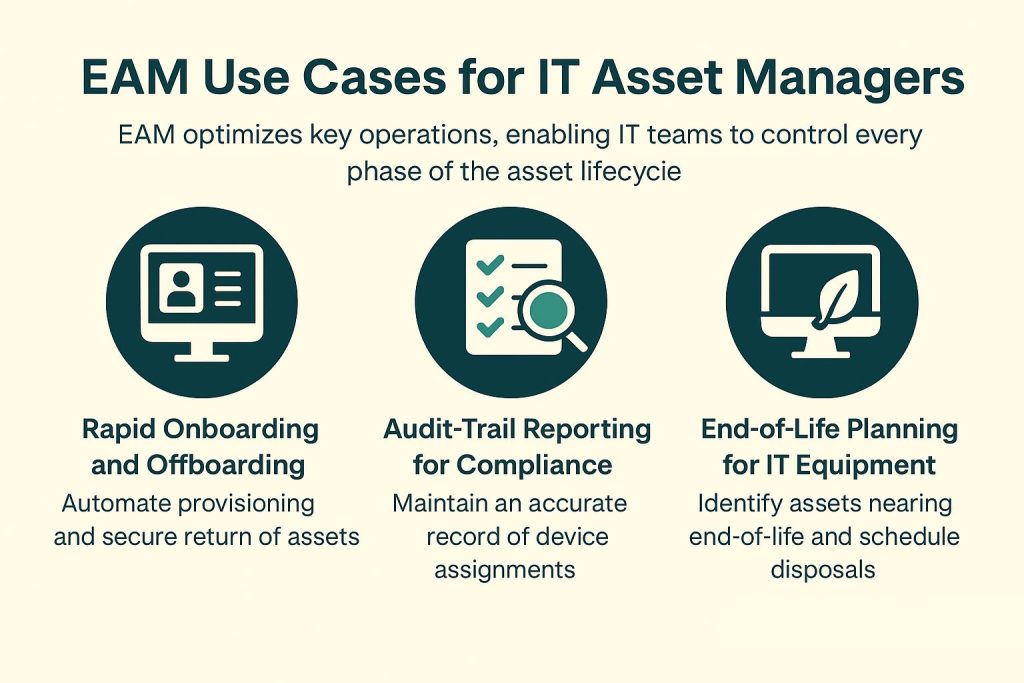
EAM optimizes key operations, which enables organizations to scale more smoothly. It delivers the right tools, such as automation, compliance, actionable data, and security controls, so IT teams can control every phase of the asset lifecycle.
Below are the key use cases for hardware and IT asset managers to drive operational gains with EAM:
- Rapid Onboarding and Offboarding
EAM systems automate the entire onboarding process when a new employee joins. Moreover, work order management helps allocate the required devices, and role-based workflows ensure seamless provisioning. These systems also enable secure return and offboarding of physical assets to prevent losses and accelerate recovery.
- Audit-Trail Reporting for Compliance
Compliance is essential for organizations to maintain operations and scale effectively. Still, regulatory demands are stricter and more complex than ever, especially for corporate hardware. EAM software can help with compliance by maintaining a precise audit trail and capturing all device assignments. In addition, it tracks maintenance activities, location changes, and compliance status of all assets in real time.
- End-of-Life Planning for IT Equipment
Lifecycle optimization is key to maximizing asset ROI. That’s why EAM tools, such as Teqtivity, offer asset lifecycle management tools to identify IT equipment approaching end-of-life (EOL). This way, organizations can schedule secure disposals and adopt environmentally responsible recycling to meet sustainability goals.
Do you want to optimize your business operations, too? Then, waste no time and use an effective EAM solution like Teqtivity. It can greatly enhance your organization’s operational efficiency and productivity with its real-time data visibility and full lifecycle management of each critical asset. Want to see these features in action? Request a free demo now and get the full demonstration.