


A scaling organization has unique challenges and requirements. That’s why maintaining a scalable enterprise IT asset management strategy is more than just a checkbox, it’s the backbone of security and operational efficiency for modern organizations.
But many enterprises struggle with creating a scalable ITAM strategy. Without this, they can face numerous challenges due to the growing number of IT assets and hardware warranties. So, how can you build a scalable enterprise IT asset management strategy? Let’s discuss this in the blog.
How ITAM Improves Basic Asset Tracking
Basic and outdated asset tracking is only useful to some extent. More importantly, it doesn’t work well for scaling organizations. However, enterprise IT asset management (ITAM) completely changes how businesses track their physical assets. It enables organizations to focus on optimizing asset usage, security, cost control, and regulatory compliance.
A modern ITAM and EAM solution, such as Teqtivity, provides way more features than a simple database. It delivers real-time data, so organizations can have a live oversight of every critical asset. This increased visibility enables organizations to make informed decisions to optimize asset utilization, maintenance, deployment, and retirement.
Below are some other advanced features of an ITAM that improve basic asset tracking:
- Asset lifecycle management
- Maintenance alerts
- Work order management
- Audit-ready documentation
- Centralized inventory tracking
That said, ITAM solutions provide organizations with deep insights, enabling them to transition from outdated, basic-level tracking to a more future-proof and scalable approach. These solutions also allow businesses to make data-driven strategies and turn their static inventory entries into valuable reports and analytics for enterprise growth.
Why Do Enterprises Need a Scalable ITAM Strategy?
Enterprises today rely on hundreds or thousands of IT assets that are critical to their key operations. However, the worst challenges arise when these enterprises start scaling. The lack of an effective ITAM solution exposes organizations to growing risks, such as the ones below:
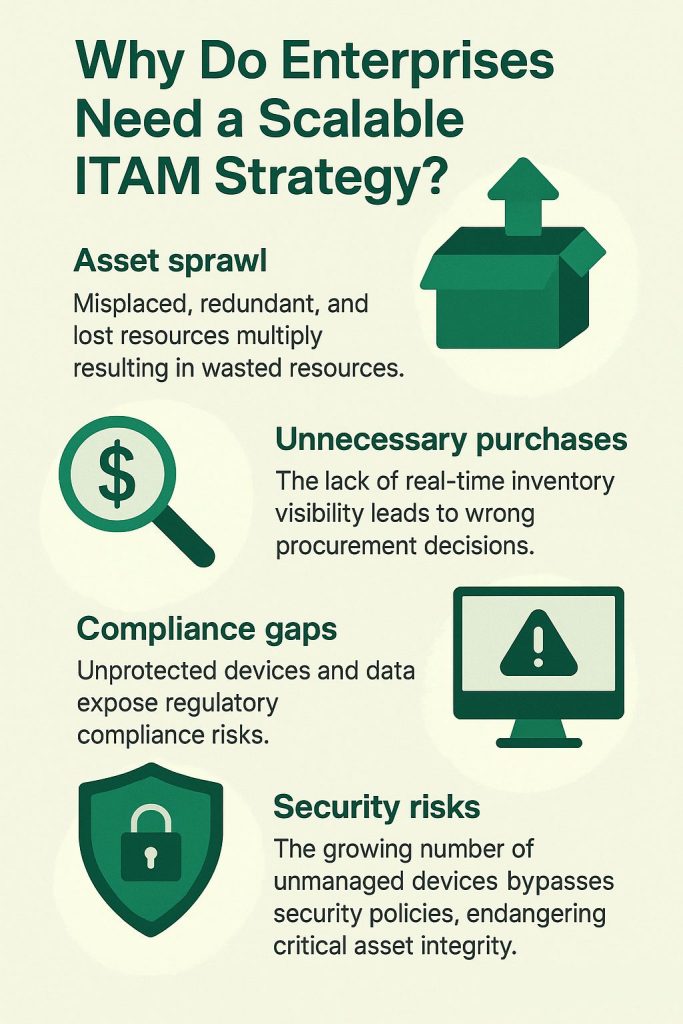
- Asset sprawl: Misplaced, redundant, and lost resources multiply, resulting in wasted resources.
- Unnecessary purchases: The lack of real-time inventory visibility leads to wrong procurement decisions.
- Compliance gaps: Unprotected devices and data expose regulatory compliance risks.
- Security risks: The growing number of unmanaged devices bypasses security policies, endangering critical asset integrity.
A scalable enterprise IT asset management strategy, like that of Teqtivity, paves the way for cost control, enhanced security, and greater operational efficiency.
- EAM solutions automate asset information tracking.
- Real-time data visibility allows enterprises to gain instant control over asset status, usage, and assignments.
- The EAM integrations enable proactive maintenance and maximize asset performance.
- An EAM’s asset lifecycle management centralizes oversight over every resource’s health and condition.
All of these EAM benefits help a business scale more smoothly. Moreover, they allow for increasing the asset portfolio and IT staff without any technological overhauls.
How Does Scalability Improve Sustainable Enterprise Growth?
Scalability is non-negotiable, especially for organizations expanding in asset volume or complexity. Modern ITAM streamlines complex workflows, such as work order management, and tracks both routine and unexpected needs. This ensures organizations can manage both planned and unplanned decisions without operational disruptions.
Also, a scalable ITAM approach ensures:
- Every new asset is seamlessly integrated with existing enterprise systems.
- Automated maintenance planning to reduce manual, administrative burdens and human error.
- Cross-team collaboration, which is critical for quick incident response.
A scalable ITAM tool, such as Teqtivity, provides enterprises with room for visibility, agility, and growth. It combines asset information across existing platforms to enable accurate, consistent, and real-time data capture throughout the entire IT infrastructure.
Building a Scalable ITAM Strategy: Step-by-Step
Today’s continuously changing IT landscape demands that enterprises move beyond outdated spreadsheets. On top of that, organizations must say goodbye to their traditional inventory processes for efficient scaling. Simply put, anything that creates data fragmentation and human error can affect an enterprise’s scalability.
That is why organizations must adopt a holistic, scalable enterprise IT asset management strategy. So, how can this be achieved? Here are the steps to build a future-proof, scalable ITAM approach:
Step 1: Set Clear Goals
Every successful enterprise IT asset management strategy starts with a clear vision. The first step is to define what success looks like for your organization. Therefore, these three factors are essential:
- Asset Performance: Improve operational uptime of assets, reduce failure rates, and maximize asset utilization.
- Cost Optimization: Eliminate duplicate purchases, allocate resources more efficiently, and extend the lifespan of assets.
- Risk Mitigation: Protect every critical asset from security threats, and compliance gaps.
It is essential to know your target. This allows you to customize the entire ITAM lifecycle, from maintenance planning to retirement—ensuring achievable outcomes at every stage.
Step 2: Map & Inventory All IT Assets
The next step is to capture a detailed inventory of all physical assets, including all laptops, mobile devices, AV equipment, and accessories. Modern EAM solutions and ITAM software provide centralized, cloud-based asset management, making large-scale asset mapping a breeze.
To add to that, use advanced technologies, such as barcodes, RFID tags, and QR scanning, to effectively label your assets. This enables your ITAM solution to track assets across multiple locations and departments. Lastly, centralization ensures that growth, mergers, or remote workforce expansions never disrupt business operations.
Step 3: Classify Assets by Risk, Value & Lifecycle
Not all assets are equal. Thus, classifying assets enables efficient maintenance strategies, priority settings, and smarter decisions for asset lifecycle management.
Here are the three main considerations for asset classification:
- Risk: Label sensitive data endpoints and regulatory devices as “high risk” to trigger additional controls and prioritize them accordingly. Therefore, secondary assets and accessories don’t consume the same resources as a high-risk one.
- Value: Always prioritize operations-critical equipment for active monitoring and predictive maintenance. Categorize your assets according to how important they are for your enterprise’s essential operations.
- Lifecycle Stage: Track every asset from its acquisition, deployment, usage, maintenance, to disposal. This way, you can identify potential issues, maintenance needs, and replacements.
Classification is one of the most overlooked steps towards scalability. It optimizes asset scheduling and replacement to align with broader business needs, opening doors for new assets and growth.
Step 4: Automate Onboarding Compliance Checks
Automation is crucial for building a scalable enterprise IT asset management strategy, especially in the modern era. It can streamline these tasks:
- Onboarding: Automated ITAM solutions can assign new hardware and activate its warranty coverage immediately after its deployment. Furthermore, they can automate document allocation history to keep detailed logs of past services, repairs, and replacements.
- Compliance: A modern ITAM system like Teqtivity improves compliance with automated checks. It ensures that no asset in the organization is violating usage policies and creating security vulnerabilities.
Automation also takes the burden off IT teams. Otherwise, they spend hours on repetitive tasks, which leads to more human errors. Surprisingly, automation can also improve your company’s data security. A study by DocuClipper further supports this point, highlighting that 95 out of 100 cyber breaches are caused by human error.
Step 5: Integrate ITAM with Other Systems
A siloed ITAM platform with data fragmentation doesn’t really support scaling. In fact, it prevents organizations from growing with frequent asset loss, mismanagement, inventory discrepancies, etc. That is why you should integrate enterprise IT asset management with these systems:
- Mobile Device Management: Laptops are among the most common IT assets in enterprises. Thus, ITAM, integrated with an MDM system, provides detailed oversight over all devices, so nothing slips through the cracks.
- Helpdesk: IT asset management synchronizes well with helpdesk platforms. It streamlines ticketing, asset data, and work order management for faster support.
- Vendor Management: It is a good idea to connect ITAM with supplier systems. This way, you can gain better visibility into purchased assets and track what’s currently in transit. All this help you to reduce delays and improve inventory planning.
- People Management Systems: A people management system, integrated with ITAM, helps keep oversight over HR-related matters. However, it can also equip you with the right onboarding/offboarding data to make informed decisions.
An ITAM system like Teqtivity prevents data silos with its integrations. This ensures you can always have consistent data, seamless workflows, and a single source of asset information truth across all departments and systems.
Step 6: Enable Automated Work Orders & Maintenance
Modern ITAM solutions provide automated work order management and full asset lifecycle management. Both of these features help you plan your maintenance activities more efficiently. Here’s how:
- Automated work order management helps coordinate tasks among the maintenance team and IT staff. So, they can quickly resolve minor fixes as well as large-scale hardware replacements and upgrades.
- Maintenance planning tools provide organizations with the essential knowledge about their assets. They can help schedule preventive maintenance to reduce unplanned breakdowns and increase asset lifespan.
The results? You face lower unplanned issues, and your assets deliver the maximum return on their investments, creating a win-win situation for your scaling enterprise.
Step 7: Conduct Regular Audits for Continuous Improvement
Regular audits are essential to identify gaps, which can cause compliance pitfalls. Moreover, these non-compliance risks prevent organizations from scaling due to unexpected legal penalties and reputational damage.
So, how to avoid this problem? Here’s what to do:
- Schedule regular audits to match digital data with physical inventory records.
- Use visual dashboards of ITAM solutions, like Teqtivity, to track all key metrics at all times.
- Utilize the insights provided by an ITAM system to continuously tighten controls and improve asset performance.
Regular audits also work as rehearsals for actual external and internal audits. In addition, audit-readiness can keep you assured that every asset in your organization is compliant with regulations.
Step 8: Deliver Reporting & Dashboards for All Stakeholders
The data and insights provided by an ITAM dashboard are not just for IT teams; they are for the entire enterprise leadership, including compliance managers. So, how to get everyone on board? Here’s how:
- Provide customized, department-specific dashboards and data to each stakeholder.
- Allow drill-downs into asset status, compliance reports, open work orders, and financial impact.
- Use an ITAM solution, such as Teqtivity, to automate reporting—which saves time and keeps everyone accountable.
This is the last, but the most important step in building a scalable IT strategy. A report by Robert Half found that 24% hybrid and 13% fully remote jobs have increased in just the last two years. And this trend is unlikely to stop soon. Therefore, enterprises need a more centralized and customizable ITAM solution that delivers the right analytics and reports to support their growth.
Key Metrics to Track for Scalability
Building the right scalability strategy isn’t enough. Enterprises must track some key metrics and utilize actionable insights for continuous growth.

Below are the key metrics of enterprise IT asset management that you MUST track for scalability:
- Asset Utilization Rate
The asset utilization rate measures how effectively your physical assets are utilized. Therefore, a higher rate for this metric ensures that organizations can optimize key operations like asset deployment, inventory management, and maximize their return on investment.
- Onboarding/Offboarding Time
Efficient onboarding and offboarding of assets minimize downtime as teams scale. Thus, enterprises must maintain a lower time-to-provisioning ratio for new hires and disposals to achieve increased operational agility.
- Audit Completion Cycles
This metric tracks the time gaps between each audit. Maintaining shorter audit cycles ensures compliance and financial accuracy, whereas longer gaps can create discrepancies.
- Maintenance Intervals & Response Time
Two of the most important metrics are maintenance intervals and average response time for work orders. You can keep these metrics efficient by integrating your ITAM with a computerized maintenance management system (CMMS). This integration equips you with predictive maintenance planning, enabling teams to manage both planned and unplanned maintenance activities effectively and minimize costly downtime.
- Depreciation Tracking
Depreciation tracking keeps you updated with accurate asset aging data. So, you can make smarter maintenance planning and budgeting decisions, aligning with compliance and sustainability goals.
Do you want a scalable ITAM solution that grows with your business? Try Teqtivity. It supports the growing needs of enterprises and their IT asset portfolios. So, organizations have one less thing to worry about and ensure continuous growth. So, how does Teqtivity help with scaling? Book a free demo now and see the full demonstration!