


These days, schools typically manage hundreds or even thousands of devices and digital resources, relying heavily on these IT assets to create an effective learning environment for students. This heavy dependence brings with it the challenge of tracking and managing all this equipment, making IT Asset Management (ITAM) absolutely essential.
However, simply using an ITAM solution isn’t enough if you don’t know which Key Performance Indicators (KPIs) to focus on. So, what are the key performance indicators for ITAM in schools? How do they help? Continue reading to find all the answers in this blog.
Why Track KPIs for ITAM in Schools?
Key performance indicators for ITAM in schools enable administrators and IT teams to manage devices, warranties, and IT resources efficiently. Moreover, they can align with educational goals to ensure that technology isn’t just present—it is supporting teaching and learning processes.
So, before moving to key performance indicators, let’s learn why tracking KPIs for ITAM is important for schools:
- Budget Optimization to Stretch Limited Funds
Budget optimization is a major advantage of tracking ITAM KPIs in schools. Since schools—especially their IT teams—often operate within tight financial constraints, effectively managing the lifecycle of assets becomes crucial for stretching limited budgets. By monitoring each device from procurement through to retirement, schools can ensure every asset is used to its fullest potential.
Inventory management tools further enhance this process by helping schools make the most of their available resources. Because, tracking key inventory metrics not only prevents duplicate purchases but also highlights underused assets. So, these practices are not just cost-effective—they are essential for ensuring the long-term sustainability of a school’s IT infrastructure.
- Security Improvement & Compliance
Security and compliance are among the most critical concerns for schools today. According to a study by TB Consulting, 73% of organizations are unprepared for cyberattacks, and the education sector is one of the most frequently targeted by cyber threats. Often, these security risks arise because many schools fail to adhere to data regulatory standards, leaving them vulnerable to data breaches. Non-compliance can also result in hefty fines, legal penalties, and reputational harm.
However, by tracking key ITAM indicators, schools can gain detailed insights into their IT asset environment. These metrics can help identify weak points that might serve as entryways for cyberattacks, allowing schools to address vulnerabilities proactively and maintain compliance with regulatory requirements.
- Enhanced Operational Efficiency
Operational efficiency is central to effective IT asset management. The primary goal of monitoring KPIs is to pinpoint areas that need improvement. Therefore, modern ITAM systems, such as Teqtivity, provide dashboards for real-time monitoring and automated alerts, enabling schools to track assets, schedule preventive maintenance, and monitor key metrics, including mean time to repair (MTTR).
This proactive approach reduces downtime and minimizes the risk of device loss or theft. It also empowers schools to make informed, data-driven decisions regarding resource allocation, hardware upgrades, and budgeting, ultimately supporting a more efficient and sustainable IT environment.
Top Key Performance Indicators for ITAM in Schools
Tracking KPIs for ITAM in schools offers several benefits, including improved efficiency, optimized budgeting, enhanced data security, and compliance with regulations. But which metrics should schools prioritize? Below are the most important KPIs every school should monitor:
| KPIs | Overview | Why It Matters for Schools |
| Asset Utilization Rate | % of time devices are in use | Identifies devices that are sitting idle or those that are being overused for better redistribution. |
| Cost Savings | Savings from optimized asset management | Helps stretch budgets, which are already tighter in schools, especially in IT departments. |
| Risk Mitigation Index | Effectiveness of security/compliance efforts | Identifies the risks associated with cybersecurity issues and non-compliance legal problems. |
| Asset Lifecycle Management | Tracks assets from purchase to retirement | To track each asset’s health throughout its life to make better decisions. |
| Vendor Performance | Vendor reliability and SLA adherence | Ensures quality service and follows up on agreements with vendors. |
| IT Asset Portfolio Health | Asset age, value, maintenance, compliance | Provides an overview of asset status to track its exact usage, value, and maintenance requirements. |
| Device Assignment | Who has which device and where | Reduces loss/theft and improves accountability by tracking devices and their assigned users. |
| Maintenance History | Log of repairs and maintenance | Maintenance and repair history tracking to prevent unexpected breakdowns and costly repairs. |
| User-to-Asset Ratio | Devices per user | Ensures fair distribution, like 1:1 programs to promote digital equity in institutions. |
The table above provides a brief explanation of the purpose of tracking key ITAM metrics in schools. Let’s discuss each KPI in detail to get a better understanding:
- Asset Utilization Rate
Asset utilization rate refers to the percentage of devices that are actively used versus idle. Remember, schools have limited digital resources. Hence, this KPI is important to see whether laptops, tablets, or projects are being utilized to improve learning and teaching or gathering dust.
A lower utilization rate indicates poor allocation. For example, devices sitting idle in one department, while others face shortages.
However, ITAM solutions, such as Teqtivity, enable schools to monitor asset usage patterns and reallocate underutilized devices. For instance, if a school discovers that its science lab equipment is only used 30% of the time, this insight can help redirect those assets to another busier class. This simple tweak optimizes asset utilization and ensures that technology directly supports teaching and learning.
- Cost Savings from Asset Management
Cost savings is another KPI that quantifies savings from data-driven procurements, reduced maintenance, and efficient asset management. Schools can lose hundreds or thousands annually to lost devices, emergency repairs, and duplicate purchases.
However, real-time asset tracking can identify these problem areas. It generates KPIs that help optimize asset lifecycle management. So, you can utilize these predictive insights to schedule preventive maintenance. Ultimately, it helps avoid costly unexpected breakdowns. The money saved can then be allocated to more critical areas to further enhance learning.
- Risk Mitigation Index
Risk Mitigation Index (RMI) is a composite metric that evaluates how effectively an ITAM solution protects data, prevents cyberattacks, and ensures compliance. This KPI is especially important for schools, as the education sector is now one of the most targeted for cyber threats, facing an average of thousands of attacks each year. Schools store sensitive staff and student information, such as contact details, addresses, and Social Security numbers, making them attractive targets for cybercriminals.
Therefore, a higher RMI is highly recommended for schools, as it indicates stronger protection and better adherence to regulatory standards. RMI tracks data encryption rates, responses to cyberattacks, and audit outcomes, providing a clear picture of an institution’s risk profile. By monitoring these indicators, schools can proactively address vulnerabilities, ensure compliance, and reduce the likelihood of costly legal penalties or reputational damage.
- Asset Lifecycle Management
Asset lifecycle management is another important metric that encompasses the entire life cycle of devices. Nowadays, schools must avoid manual methods to monitor assets. These outdated approaches can cause missed maintenance opportunities and premature asset disposal.
Thus, asset lifecycle management monitors the age, depreciation, repair costs, and retirement timelines of each device. This data allows schools to automate warranty tracking and schedule preventive maintenance.
For example, if a laptop nearing the end of its life cycle is assigned to a student at the start of a new academic year, it may fail unexpectedly, causing disruptions when the budget is already set. So, the only two options left are costly emergency repairs or unplanned replacements.
Now, imagine a scenario where a lifecycle management tool like Teqtivity alerts you in advance that the laptop will reach its end-of-life in 2026. Then, you can make budget-conscious decisions proactively and avoid learning disruptions.
- Vendor Performance and SLA Compliance
This KPI assesses vendor reliability, delivery times, and follow-ups upon service agreements. Schools may deal with multiple vendors, such as device suppliers or cloud service providers. Thus, they need to monitor the quality of asset support.
Vendor-centric metrics include response times, resolution rates, and SLA (Service Level Agreement) breaches. Tracking these metrics provides an objective way to evaluate vendor performance and ensures accountability for service quality. Therefore, asset management systems like Teqtivity can integrate seamlessly with other platforms. This integration allows schools to log and manage vendor interactions in a centralized location, making it easier to track performance and streamline issue resolution.
- IT Asset Portfolio Health
IT asset portfolio health is a key metric that assesses the age, value, maintenance costs, and compliance status of assets. It answers an important question: “Is our technology thriving or failing?”
A school can use this KPI to balance portfolios. For instance, they can shift their valuable resources from aging desktops to cloud-based tools for increased accessibility.
Thus, modern ITAM tools like Teqtivity provide real-time visualizations and reports, allowing schools to instantly identify high-risk assets, such as devices that require frequent repairs or are nearing end-of-life. Therefore, they can make data-driven decisions to ensure that investments align with educational priorities.
- Device Assignment and Location Tracking
This KPI tracks the assigned user and usage location of a device. It is essential to minimize loss and prevent issues like misplacement or theft.
In fact, a recent study finds that a single laptop with its digital resources and security tools can cost upwards of $1,500. Therefore, losing a single device can cost financial losses of hundreds or thousands of dollars.
However, asset tracking tools can mitigate this risk. Tools like Teqtivity use barcode and QR scanning technologies to track each asset. Therefore, by utilizing these technologies, schools can automate asset audits, maintain accurate inventory records, and instantly update the last known location whenever a device is scanned. They can therefore monitor the live location of each device.
With advanced asset location tracking, schools can quickly recover misplaced or stolen devices, reducing downtime and replacement costs. So, today, when schools have hundreds or thousands of IT assets, this KPI is non-negotiable.
- Maintenance and Repair History
Maintenance and repair history logs fixes, plans upgrades, and predicts failures. A higher rate of time to repair (MTTR) can disrupt learning. However, this KPI drives it down.
But, asset management software can solve this problem with automation. They automate work orders and track MTTR. Moreover, they use historical data to forecast potential issues.
For example, if a tablet has undergone multiple repairs and part replacements, an ITAM solution like Teqtivity will flag the device and prompt administrators to replace it before it fails again. Therefore, schools can cut unexpected failures or downtime that directly impact learning.
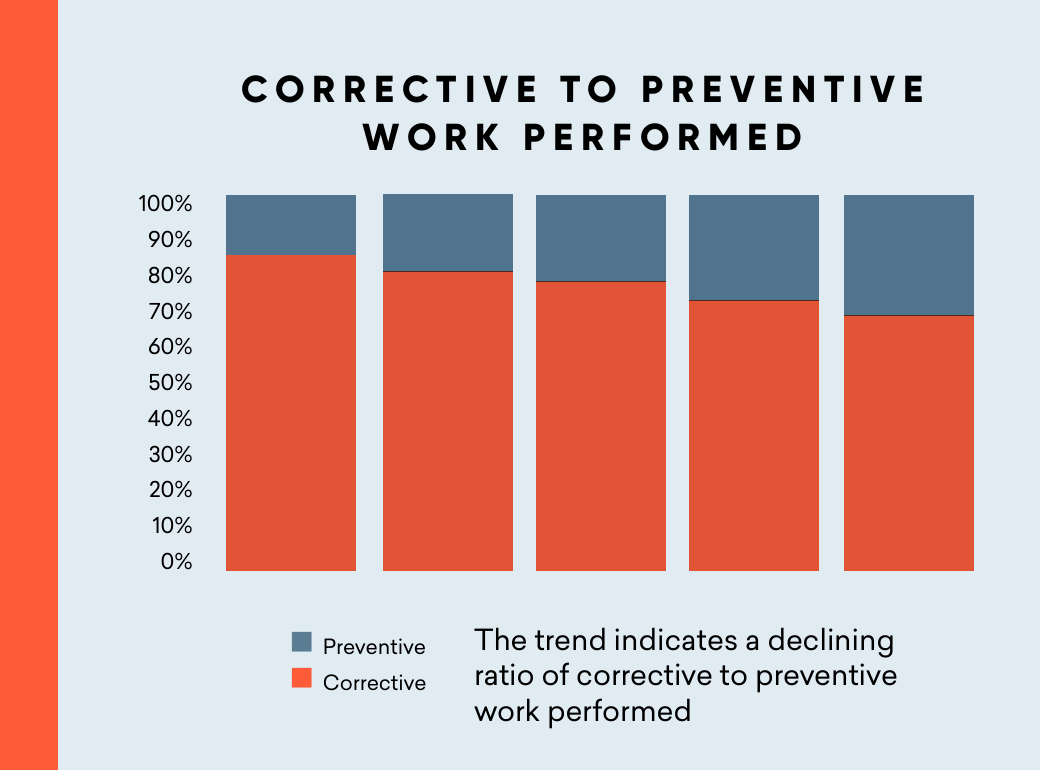
SOURCE: Brightly Software
The graph above illustrates the declining trend in corrective maintenance. It highlights the increasing ratio of preventive maintenance, which is highly effective in schools.
- User-to-Asset Ratio
The User-to-Asset Ratio is a key indicator for equitable device distribution. Generally, K-12 schools prefer the 1:1 student-to-device adoption. However, a lack of balance can strain resources.
For instance, some classrooms will be overcrowded with idle devices, while others will face shortages. These problems can create digital inequity, which causes institutions to lose community trust.
By tracking the user-to-asset ratio through inventory management reports, schools can identify underutilized or over-allocated assets and reassign them as needed. And, ITAM solutions like Teqtivity ensure there are no underused or overused devices to optimize budgets.
Best Tips to Implement ITAM KPIs in Schools
Implementing and tracking key performance indicators for ITAM in schools can be quite beneficial. It turns fragmented technology management into a streamlined, data-driven approach.
But, consider adopting the following best tips with the ITAM KPIs to get the best results:
- Regularly Review Asset Usage Data
You can utilize a real-time dashboard, such as Teqtivity, to track asset performance, usage trends, and maintenance requirements. This approach allows schools to make proactive, data-driven decisions, quickly identifying areas for improvement and ensuring optimal resource allocation.
- Set Clear Goals and Benchmarks
It is also important to align your key performance indicators with the school’s broader objectives. For this, you can start by defining measurable objectives for lifecycle management, warranty tracking, and compliance. Then, track progress against these benchmarks.
Remember, clear goals help focus effort. It also ensures that every step in your management process contributes to the school’s overall success.
- Train Staff on ITAM Tools
Another good step to take is to empower all staff members. You should train them with the knowledge and skills to use asset management software. Because inventory management becomes more accurate when everyone understands how to track devices, generate reports, and respond to alerts.
Moreover, training can also enhance accountability throughout the institution. It equips teams with proactive knowledge, which is essential for long-term sustainability.
- Automate Where Possible
Automation is the key to minimizing errors and reducing manual work. So, set up automated alerts for maintenance, warranty updates, and overdue devices. This automation will free up your team to focus on more important tasks. By doing so, you can increase efficiency and reduce the risk of oversight.
- Continuously Improve Processes
Lastly, use the insights from your key performance indicators for ITAM in schools to refine your asset management strategies. That is because regularly analyzing KPI data helps identify problem areas and predict future needs, and drives continuous improvement in your technology management.
Overall, a tool like Teqtivity provides all the essential KPIs that you can monitor to improve your school’s operations. Want to see how it works? Request a free demo now!