


An enterprise regularly deals with thousands of assets, including laptops, mobile devices, AV equipment, and critical IT infrastructure. What if an asset gets lost? In fact, that is quite possible and happens frequently in many enterprises that don’t use effective methods to manage their devices.
The best way to efficiently track your assets, even across multiple locations, is by using an enterprise asset management system. This system can reduce the burden of manual tracking for IT teams. But what is enterprise asset management? Let me make it easy for you to understand.
What is Enterprise Asset Management?
These days, enterprises rely heavily on complex hardware and IT infrastructures to maximize their operational efficiency. Therefore, it is essential to know what Enterprise Asset Management (EAM) is. EAM can play a major role in helping organizations gain visibility and control over their assets to maximize value.
Enterprise asset management (EAM) is a strategy for monitoring, maintaining, and optimizing the entire lifecycle of an organization’s assets. It can track a device from its acquisition through everyday use, maintenance, and eventual disposal. Moreover, a modern EAM solution provides you greater control over IT assets of all types, including physical assets like laptops, network devices and servers to their warranties and vendor agreements.
Therefore, this approach offers major advantages over outdated and legacy systems that focus solely on inventory management. EAM solutions provide a unified, data-driven framework with real-time data and advanced analytics to manage assets across every stage of their lifecycles. The result? IT teams can get better transparency over every critical asset. They can even see the asset’s performance, location, and potential security and compliance risks.
Enterprise Asset Management from Acquisition to Disposal
One of the key benefits of an effective EAM strategy and solution is that it covers all stages of the asset lifecycle management. That includes:
- Procurement: EAM solutions allow acquiring hardware, warranties, or equipment with data-driven decisions and organizational needs.
- Deployment: An effective EAM strategy allocates assets through automated processes to improve efficiency.
- Operation: Enterprise-specific solutions, such as Teqtivity, monitor asset status and performance through real-time data dashboards. It ensures timely asset maintenance to proactively maintain equipment.
- Maintenance: Many EAM solutions implement both predictive maintenance and preventive maintenance strategies to prevent unplanned downtime and extend asset longevity.
- Decommissioning: Effective enterprise asset management systems securely retire and replace assets once they have reached the end-of-life. This ensures compliance with data security and sustainability standards.
In short, EAM provides the much-needed oversight for enterprises to track their essentials. A good strategy, combined with an effective solution, offers proactive management of physical assets to reduce shadow IT risks and improve compliance.
Moving Beyond Inventory: Lifecycle Optimizing
A modern EAM solution is not limited to typical inventory management. It does that, but offers so much more, including automated workflows, work order management, and integrations with MDM, HRIS, and ITAD. This allows IT teams to consolidate asset data and deliver actionable insights.
Today, an enterprise asset management (EAM) solution, such as Teqtivity, enables organizations to:
- Implement advanced inventory management to ensure that assets are always available when needed. So, organizations can never face unplanned downtime and operational disruptions.
- Set maintenance schedules and align them with critical operations to maximize uptime and maintain optimal asset health.
- Improve supply chain management to support transparency and resource optimization. This creates collaboration among internal teams and vendors.
In short, modern EAM systems don’t limit themselves to traditional inventory management processes. Instead, they focus more on asset lifecycle management, so organizations can reduce risks and increase cost savings.
Core Components of Enterprise Asset Management
Modern EAM solutions focus on data-driven lifecycle management with a holistic approach to support remote and hybrid work teams. In fact, a study by Archie found that 64% of industry leaders say their company uses a hybrid model.
Therefore, enterprises use an EAM system to track physical assets across multiple locations and departments. Below are the core components of an enterprise asset management solution:
| Component | What It does? |
| Asset Lifecycle Management | End-to-end process of planning, procuring, deploying, utilizing, maintaining, and retiring physical assets and IT infrastructure. |
| Centralized Asset Tracking & Real-Time Visibility | Unified, system-wide platform for tracking asset locations, utilization, and health using real-time data dashboards for IT and hardware. |
| Maintenance Automation & Data-Driven Schedules | Automated alerts for maintenance scheduling allow organizations to take a proactive approach to maintenance and repairs rather than a corrective one. |
| Integration With Business Systems | Seamless connection to ITAD, MDM, and HRIS to provide a unified data and eliminate fragmentation. |
| Data & Intelligence | Leveraging asset data and analytics to optimize decision-making, risk reduction, and long-term planning for asset maintenance and lifecycle strategies. |
The table above highlights the core components of enterprise asset management. Now, let’s discuss these components in detail to get a better understanding:
- Asset Lifecycle Management
Asset lifecycle management has become essential and almost non-negotiable in enterprises. It is one of the key components of a successful EAM strategy as it covers the entire lifespan of assets.
The core function of asset lifecycle management is to adopt a proactive approach in organizations. This proactive strategy enables you to monitor your devices and set maintenance activities accordingly. It can significantly help organizations prevent unplanned breakdowns, which could disrupt critical operations and lead to costly repairs.
Furthermore, it can provide detailed monitoring of an asset’s health. This simple tweak allows organizations to predict potential failures and performance dips in a device. It can also help you proactively replace equipment that could be damaged with further usage. So, you can save it for later, more critical usage, while currently utilizing the underused devices.
- Centralized Asset Tracking & Real-time Visibility
Centralization is a must-have to track your hundreds or thousands of assets in real time. This also gives you an edge over your competitors in an asset-intensive industry. Moreover, centralization provides these benefits:
- You can track all the important data in unified, visual dashboards to monitor assets’ locations, usage, and health across multiple places.
- Organizations can improve their inventory management to minimize loss, prevent buget drains, maintain data integrity, and support better decision-making.
- Work order management gets easier with EAM solutions like Teqtivity, which use automation to swiftly and smartly trigger work orders.
- Enterprises can avoid data silos, which can cause IT teams to spend hours searching for the required data. Instead, a centralized platform provides a single source of truth throughout all platforms.
- Maintenance Automation & Data-Driven Schedules
Planning maintenance can be a challenge for enterprises. As a result, many organizations can even fall for over-maintenance or under-maintenance, which are both significantly budget-draining. Effective asset management tools, such as Teqtivity, automate maintenance schedules and predictive maintenance.
EAM provides the essential data that organizations need to effectively set maintenance schedules. A report by PwC suggests that 60% of maintenance professionals believe data availability is a critical success factor for predictive maintenance. So, with Teqtivity, you can focus on other, more value-driven tasks, while automation handles all maintenance alerts and reminders.
- Integration with Broader Business Systems
Just like enterprises use thousands of IT assets, they rely on various management systems. However, EAM solutions can integrate with some of the most widely used business systems, which include:
- Mobile Device Management: Integration with MDM is crucial to maintain control over mobile assets. Teqtivity provides an even better oversight with discrepancy reports and automated workflows.
- IT Asset Disposition: EAM integration with ITAD helps create a seamless connection with your ITAD provider. This enables you to streamline compliance processes and ensure audit readiness.
- People Management: An effective EAM tool can connect with your HR platforms to synchronize data for seamless onboarding and offboarding.
- The Value of Data and Intelligence
Real-time data and advanced analytics within enterprise asset management software are important. They can help with:
- Achieving analytics that help IT departments forecast future asset needs, optimize usage, and set accurate maintenance schedules.
- Real-time monitoring to support data-driven resource allocation and faster problem detection for increased efficiency.
Key Benefits of EAM for IT & Hardware Assets
Modern EAM solutions offer benefits that outweigh traditional inventory management software and outdated spreadsheets. Here are some key advantages of EAM for IT & hardware assets:
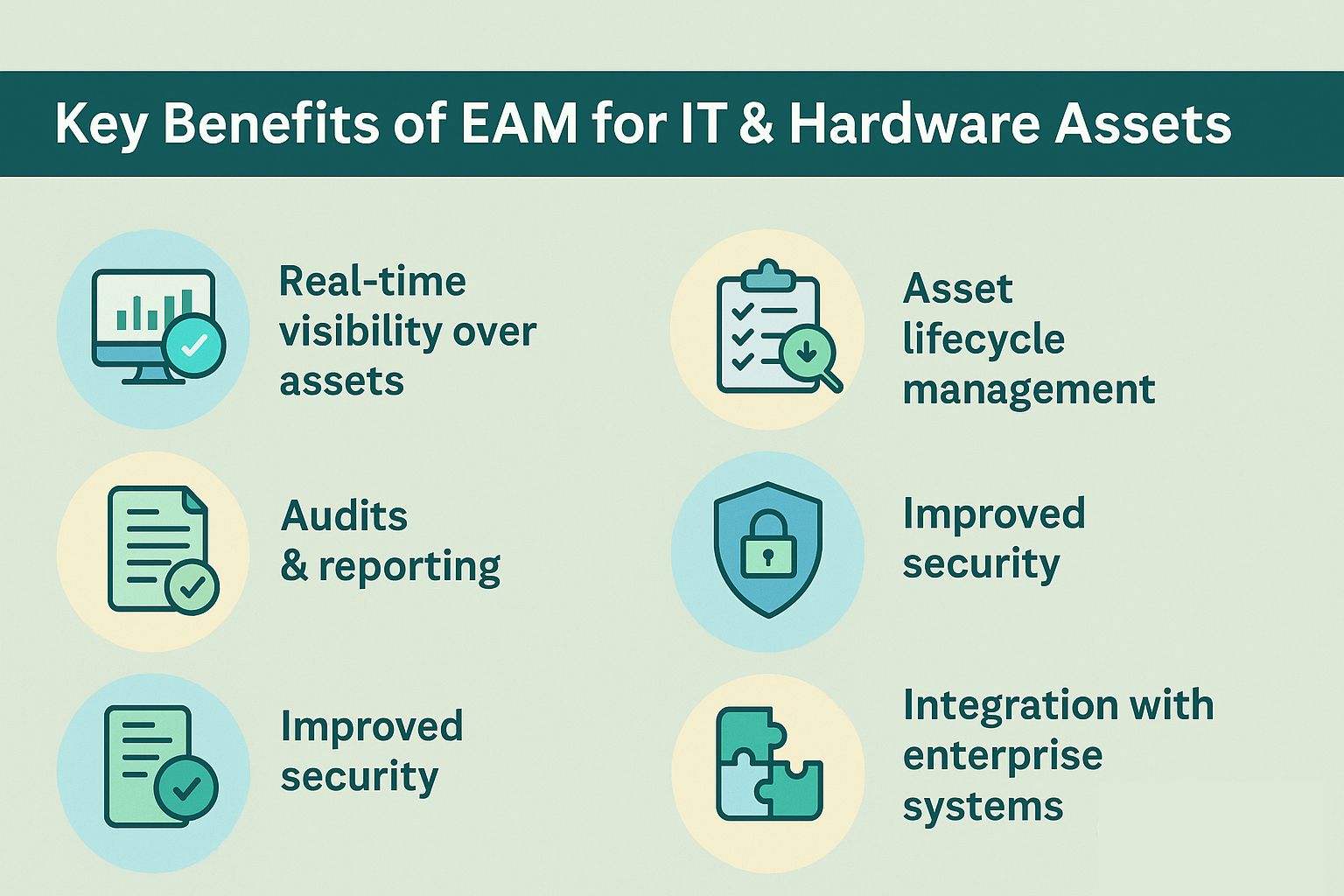
- Centralized EAM solutions provide unified dashboards, offering real-time visibility over all physical assets, so no devices go missing or are stolen, even during staff transitions.
- Real-time audits and detailed reporting enable IT teams to proactively monitor hardware health and identify small issues before they escalate.
- Full asset lifecycle management allows organizations to implement smart maintenance schedules and use predictive maintenance strategies to maximize uptime and extend asset lifespan.
- EAM tools like Teqtivity provide customized documentation, policy enforcement, and audit-ready trails to help businesses comply with industry regulations.
- Security measures of an effective EAM solution can prevent cyberthreats. Or at the very least, they can provide you with the tools for quick and efficient recovery after an incident.
- EAM solutions integrate well with existing enterprise solutions. This enables organizations to prevent data silos and maintain unified data across all platforms, including MDM, ITAD, and HRIS.
- You get actionable data and insights about your assets with an EAM system, which enables you to make informed decisions about resource allocation, stocking, and repairs/replacements.
Hopefully, now you have the complete answer to “what is enterprise asset management.” So, are you ready to implement one in your enterprise? Teqtivity offers a powerful EAM solution with lifecycle management, seamless integrations, real-time visibility, compliance support, security tools, and audit-ready documentation. Ready to test it out? Click here to book a demo and see how it works.